Report Title: Decoding Heat-Resilient Chloroplast Development: The Central Role of GUN1
On December 31, 2025, a research article entitled “Biogenic Retrograde Signaling via GUN1 Ensures Thermotolerant Chloroplast Biogenesis during Seedling Establishment in Arabidopsis thaliana” was published in the Journal of Integrative Plant Biology (JIPB). This study uncovers a previously unrecognized role of GUN1, a central regulator of biogenic retrograde signaling, in safeguarding chloroplast biogenesis during the earliest stages of seedling establishment under elevated temperature. In contrast to earlier work that primarily examined heat responses in established seedlings or mature plants, the authors demonstrate that chloroplast development during germination represents a particularly vulnerable developmental window. During this stage, GUN1 is indispensable for sustaining photosynthesis, chloroplast translation, and reactive oxygen species (ROS) homeostasis even under moderate heat stress. Consistent with this role, GUN1 overexpression markedly enhances thermotolerance, whereas loss of GUN1 results in severe photobleaching, defective thylakoid formation, and an inability to recover following heat exposure.
Mechanistic analyses reveal that successful chloroplast development under heat stress requires tight temporal control of photosynthesis-associated nuclear gene (PhANG) expression until plastids are competent to assemble functional photosystems. Genetic analyses place GUN1 upstream of GLK1/GLK2-dependent regulation of photosynthetic gene expression, while parallel analyses of EXECUTER (EX) 1 and EX2 reveal that chloroplast-derived ROS signaling contributes to the heat-sensitive outcomes observed in the absence of GUN1. Rather than directly coordinating these pathways, GUN1 functions to maintain a developmental and physiological state that prevents excessive ROS accumulation and inappropriate activation of EX-dependent operational retrograde signaling. In gun1 mutants, premature or misregulated expression of PhANGs leads to elevated ROS levels and thylakoid instability, providing a mechanistic explanation for their pronounced heat-sensitive phenotype.
Beyond its conceptual advances, this work directly supports key objectives in plant stress biology and crop resilience research. By linking GUN1-mediated biogenic retrograde signaling to heat stress adaptation, the study advances efforts to define organelle-to-nucleus communication mechanisms under environmental stress. The identification of a regulatory module comprising GUN1, GLK1/GLK2, and EX1/EX2 provides a molecular framework for chloroplast stability during early seedling establishment at elevated temperature. Comprehensive loss-of-function, overexpression, and genetic interaction analyses offer strong functional validation of stress-adaptation pathways and demonstrate their physiological relevance under heat stress. Importantly, the enhancement of thermotolerance through GUN1 overexpression highlights a promising translational avenue for engineering heat-resilient crops and improving seedling survival under increasingly variable climatic conditions.
The corresponding author of this study is Professor Chanhong Kim from the Center for Excellence in Molecular Plant Sciences, Chinese Academy of Sciences. The first author is Shan Qi, a PhD student, with Chaojun Cui, a postdoctoral researcher at the same institute. Additional contributors include Dr. Mengping Li, currently a postdoctoral researcher at the University of Geneva; Jieya Xia and Mengshuang Li, PhD students at the Center for Excellence in Molecular Plant Sciences; and Professor Jong-Seong Jeon from Kyung Hee University, Republic of Korea.
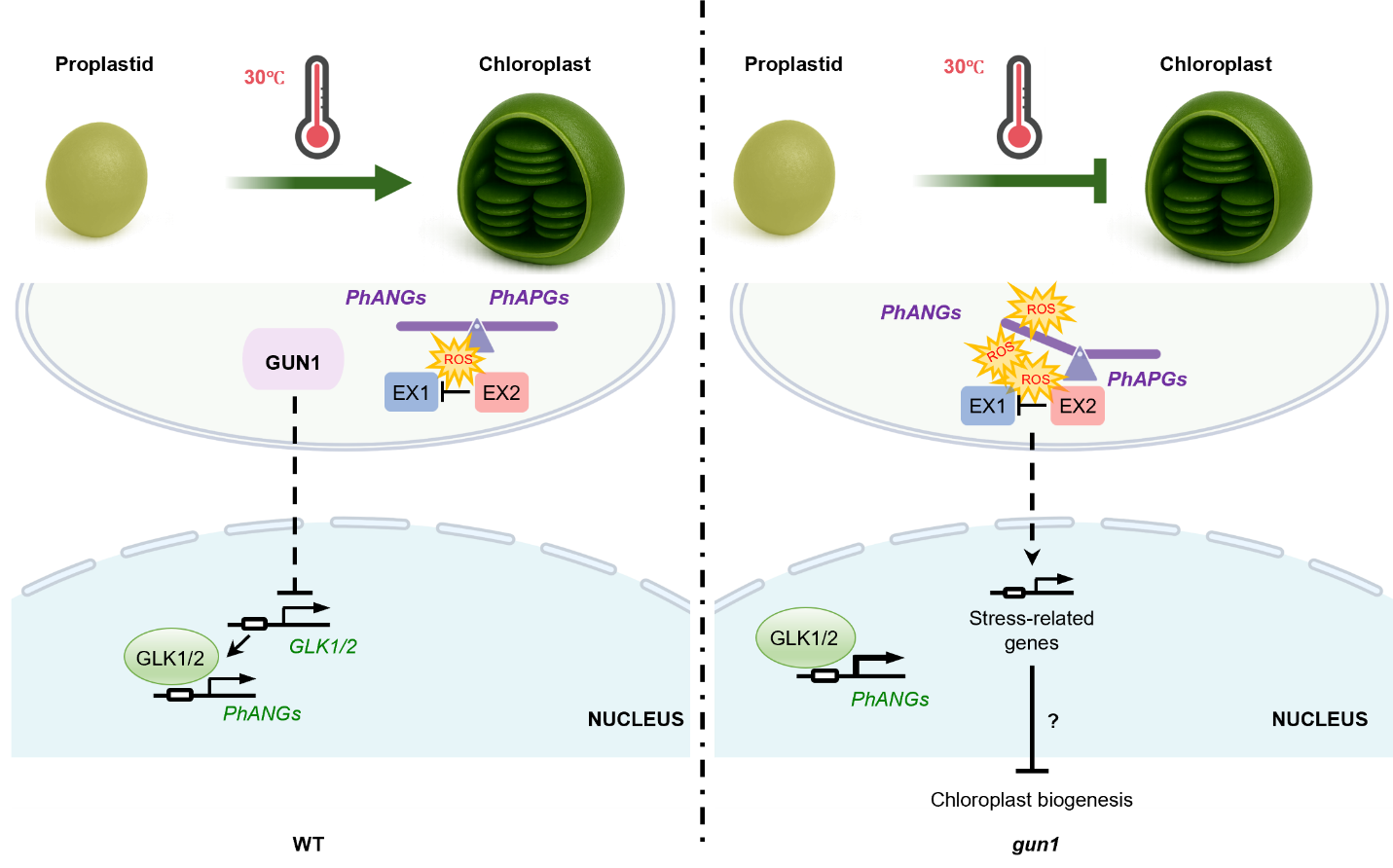
Fig. 1. Proposed model of GUN1-dependent biogenic signaling in heat stress tolerance during early chloroplast biogenesis.
Loss of GUN1 leads to de-repression of GLK1/2, key transcription factors that promote chloroplast biogenesis, even under heat stress. This results in the uncoupled expression of PhANGs in response to heat-stressed plastids, leading to the accumulation of chloroplast-derived ROS, including 1O2, and ultimately the failure of chloroplast biogenesis. The nuclear-encoded chloroplast protein EX1, a 1O2 sensor, detects elevated levels of 1O2 via its C-terminal SOS domain and activates operational retrograde signaling to induce stress-related gene expression. Whether this stress gene upregulation directly inhibits chloroplast biogenesis remains to be determined. Meanwhile, the EX1-like protein EX2 antagonizes EX1, attenuating EX1-mediated 1O2 signaling in gun1.
This research was supported by the National Natural Science Foundation of China (NSFC) (grant nos. 32350710188) and the Open Research Fund of the State Key Laboratory of Plant Trait Design (grant no.PDKF001 ) to C.K..
Article Link:https://onlinelibrary.wiley.com/doi/10.1111/jipb.70127

Copyright @copy 2002-
CAS Center for Excellence in Molecular Plant Sciences / Institute of Plant Physiology and Ecology
All rights reserved
Address: 300 Feng Lin Road, Shanghai 200032, China
Tel: 86-21-54924000
Fax: 86-21-54924015
Email: webmaster@sippe.ac.cn