Epidermal Trichomes Defend Tomato Against the Leafminer
The tomato leafminer has been an invasive pest in China since 2017 and has caused devastating losses in tomato production. Because this pest mines inside leaves, routine pesticides cannot reach or kill it. Therefore, developing the tomato’s own pest resistance is the most efficient and environmentally friendly pest management strategy. Wild tomato relatives harbor many pest-resistance genes and are a treasure trove for pest-resistance breeding, but the mechanisms and application pathways remain unclear.
On September 23, 2026, a research group led by Prof. Li Jiancai from the Center for Excellence in Molecular Plant Sciences, Chinese Academy of Sciences, published a study in Current Biology titled “Trichome acylsugar defenses are equally effective against leaf-mining and free-living insects.”
The research team first identified the wild tomato germplasm Solanum pennellii, which has robust defense against the tomato leafminer. Its most obvious phenotype is that it accumulates large amounts of acylsugars (sugar esters) specifically synthesized in the epidermal trichomes of tomato leaves. The researchers carefully monitored the feeding behavior of the tomato leafminer and found that it completely avoids contact with trichomes, raising an interesting scientific question: how do trichome-derived metabolites work if the insect does not touch the trichomes?
By analyzing metabolites in the frass of the tomato leafminer, the researchers confirmed that trichome-derived acylsugars were ingested by the pest. In addition, knocking out acylsugar biosynthetic genes specifically expressed in trichomes greatly reduced the wild tomato’s pest resistance and also eliminated acylsugars in the frass. Using MALDI technology, the researchers directly observed clear accumulation of acylsugars in the mesophyll in response to tomato leafminer infestation.
This study further identified the transporter ABCB5, which controls the translocation of trichome-derived acylsugars into the mesophyll in response to leafminer infestation. Genetically knocking out ABCB5 in the wild tomato eliminated the mesophyll-localized acylsugars in response to tomato leafminer infestation. This study elucidates how leafminer infestation triggers ABCB5-mediated translocation of trichome-derived acylsugars to the mesophyll, where they enhance resistance against leafminers.
Prof. LI Jiancai is the corresponding author of this work, and assistant researcher SUN Zongyan is the first author. PhD students PAN Xiaochan, ZHANG Yirui, and others also contributed to this work. Prof. JI Minbiao and Shimadzu Company jointly provided technical assistance for this study. The research was supported by the State Key Laboratory of Plant Trait Design and the National Natural Science Foundation of China.
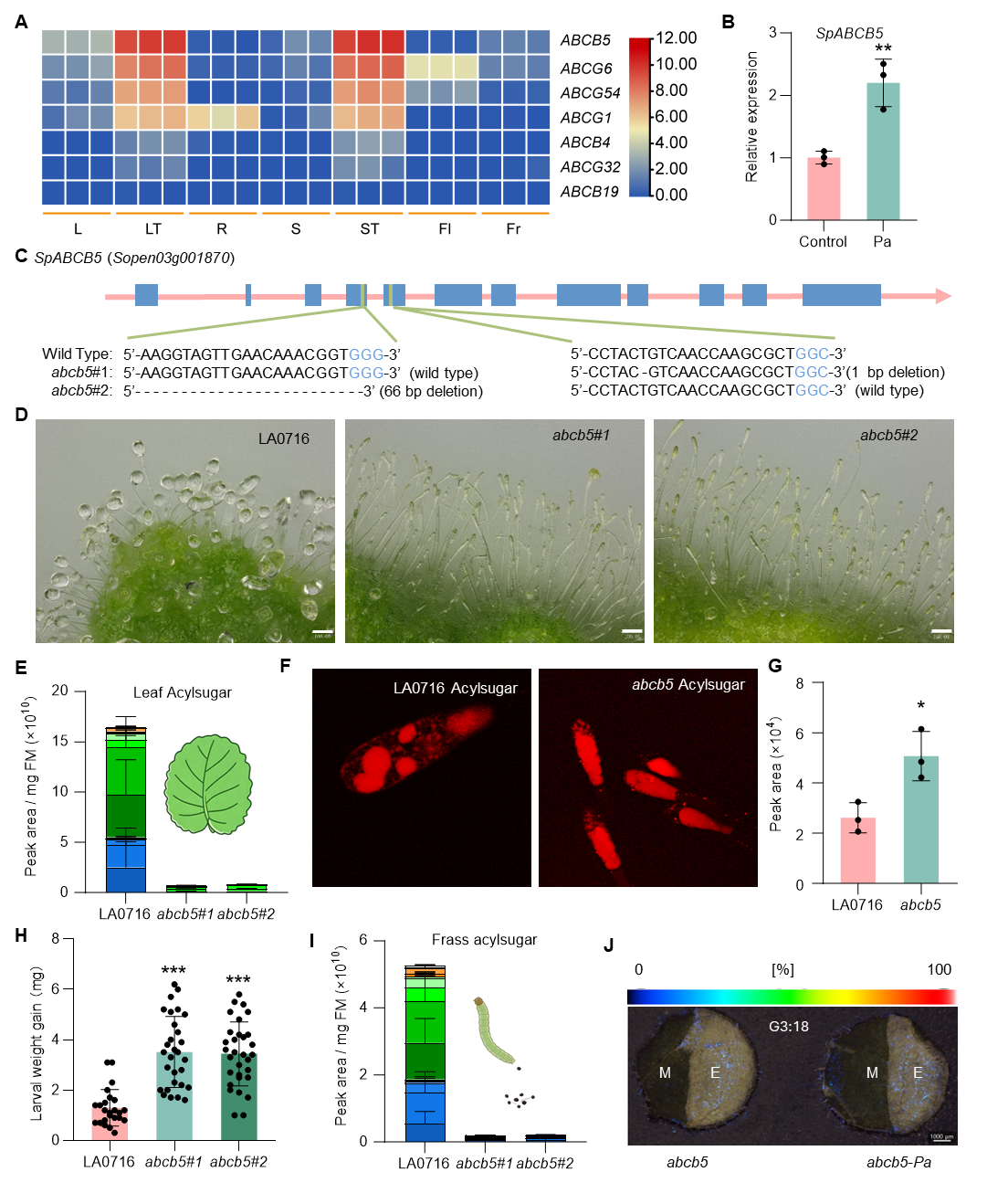
Fig. 1. SpABCB5 contributes to the trichome-mesophyll acylsugar translocation
Article Link:https://www.cell.com/current-biology/fulltext/S0960-9822(26)01120-6
Contact: jcli@cemps.ac.cn

Copyright @copy 2002-
CAS Center for Excellence in Molecular Plant Sciences / Institute of Plant Physiology and Ecology
All rights reserved
Address: 300 Feng Lin Road, Shanghai 200032, China
Tel: 86-21-54924000
Fax: 86-21-54924015
Email: webmaster@sippe.ac.cn